Method & colours methodcoloursdegrees

Reading the colours: the note, its place in the scale, or nothing

Reading the colours means answering three independent questions: what the colour says, whether shared notes split apart, and whether chords are drawn. Three settings, valid on an acoustic handpan and an electronic one alike.
Reading the colours: the note, its place in the scale, or nothing

Whether your handpan is acoustic or electronic, a colour can say two things.

It can say which note you have under your fingers. Or it can say which place that note holds in your scale.

These are two different readings of the same instrument, and both are right.

The app doesn’t choose for you: it lets you choose. It’s a setting, it takes one click, and it’s called ChromaKeys.

To see this language in motion, here is the first video of the series about the app.

Un nouveau langage visuel pour apprendre le handpan grâce aux couleurs, la géométrie et les émotions

On a handpan, the note in the centre is domed: that’s the ding. The other notes are hollowed into the metal. Here, they are all simply called notes.
Acoustic · D Kurd 10Electronic · Neotone Mutant
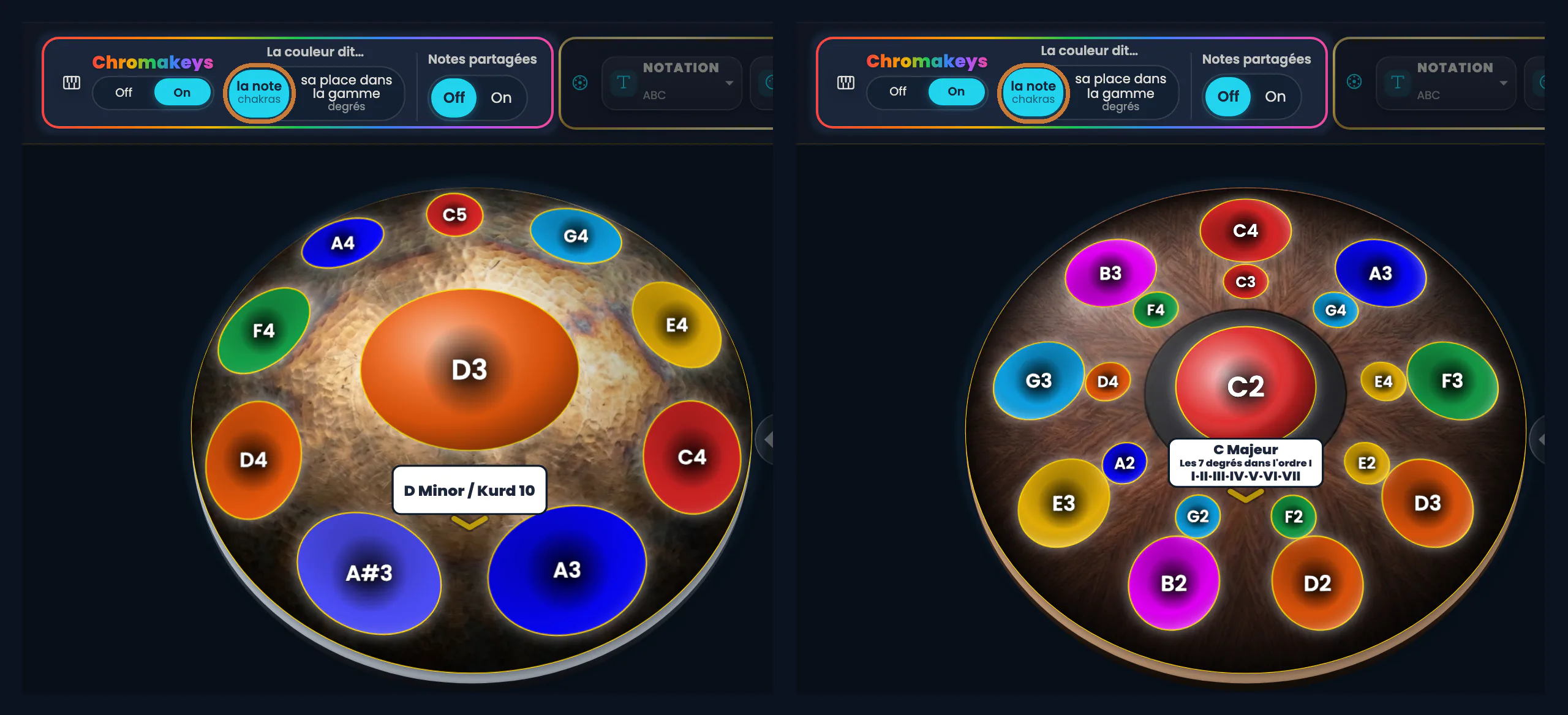
Two captures side by side, same setting. On the left, an acoustic D Minor / Kurd 10 handpan; on the right, a 19-note Neotone Mutant in Logic mode, anchored in C major. Above each, the Chromakeys island, with a copper ring around the “the note” choice. Left: the D3 ding and D4 orange, A3 and A4 indigo, A#3 light indigo, C4 and C5 red, E4 yellow, F4 green, G4 sky blue. Right: the Cs red (C2 in the centre, C3, C4), the Ds orange, the Es yellow, the Fs green, the Gs sky blue, the As indigo, the Bs magenta.
Colour set to the note (circled in copper), on an acoustic pan and on an electronic pan. Ten notes on one side, nineteen on the other, and the same rule: one note, one colour. (Screenshots of the French interface.)

Click the image to open it, then click again for full size.

And what if the colour said nothing? Under the ChromaKeys name there is an Off / On switch. On Off, the colours go out and the pan is bare metal again. On On, they come back.
ChromaKeys OffChromaKeys On
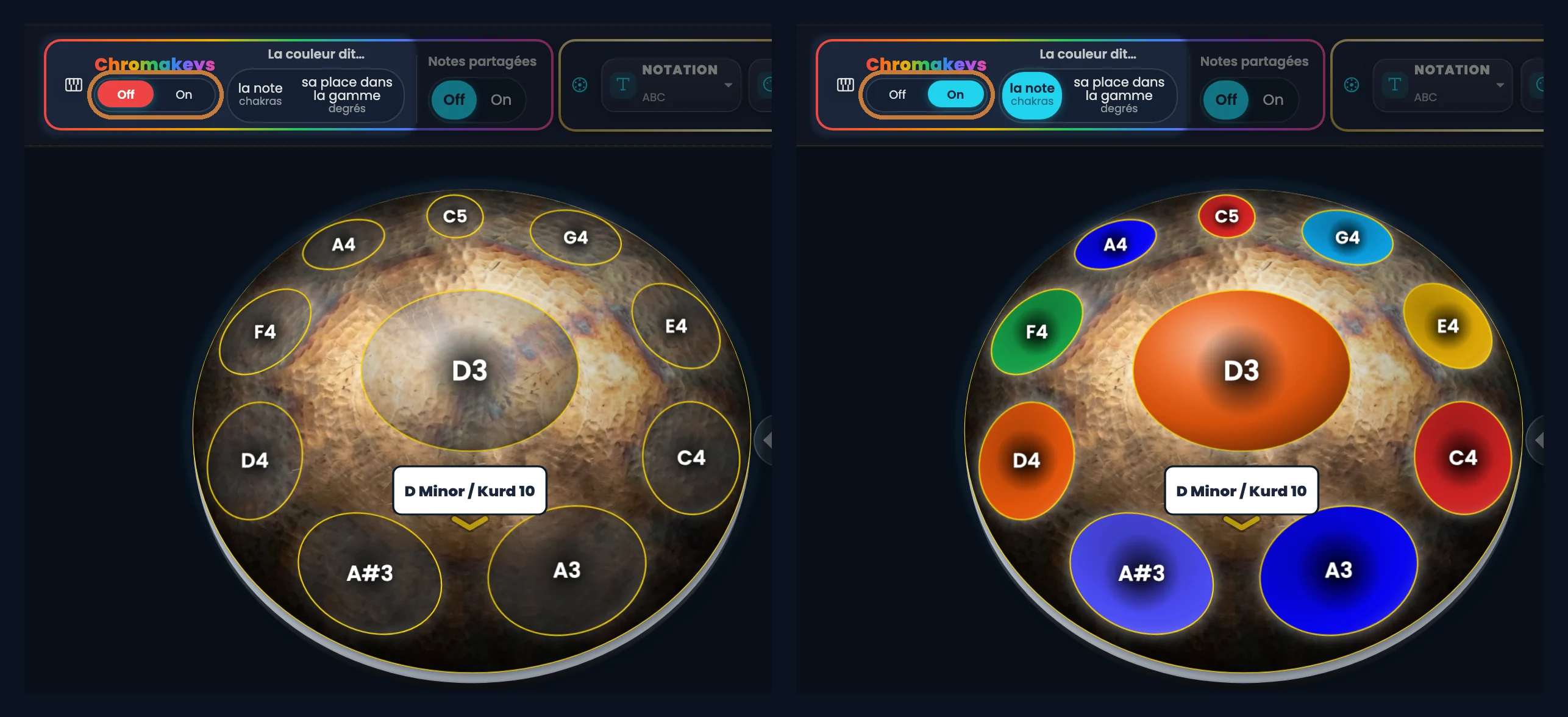
Two captures side by side of the same acoustic D Minor / Kurd 10 handpan, same framing, with the Chromakeys island above. A copper ring circles the Off/On switch on each half; the rest of the bar is slightly dimmed. Left, the switch is Off: the ten notes have no colour, only their outline and their name on the metal. Right, it is On and the colour says “the note”: the D3 ding and D4 orange, A3 and A4 indigo, A#3 light indigo, C4 and C5 red, E4 yellow, F4 green, G4 sky blue.
The same D Kurd 10, ChromaKeys Off on the left, On on the right: without colour every note looks alike; with it, you tell them apart at a glance. (Screenshot of the French interface.)

Click the image to open it, then click again for full size.
ChromaKeys OffChromaKeys On
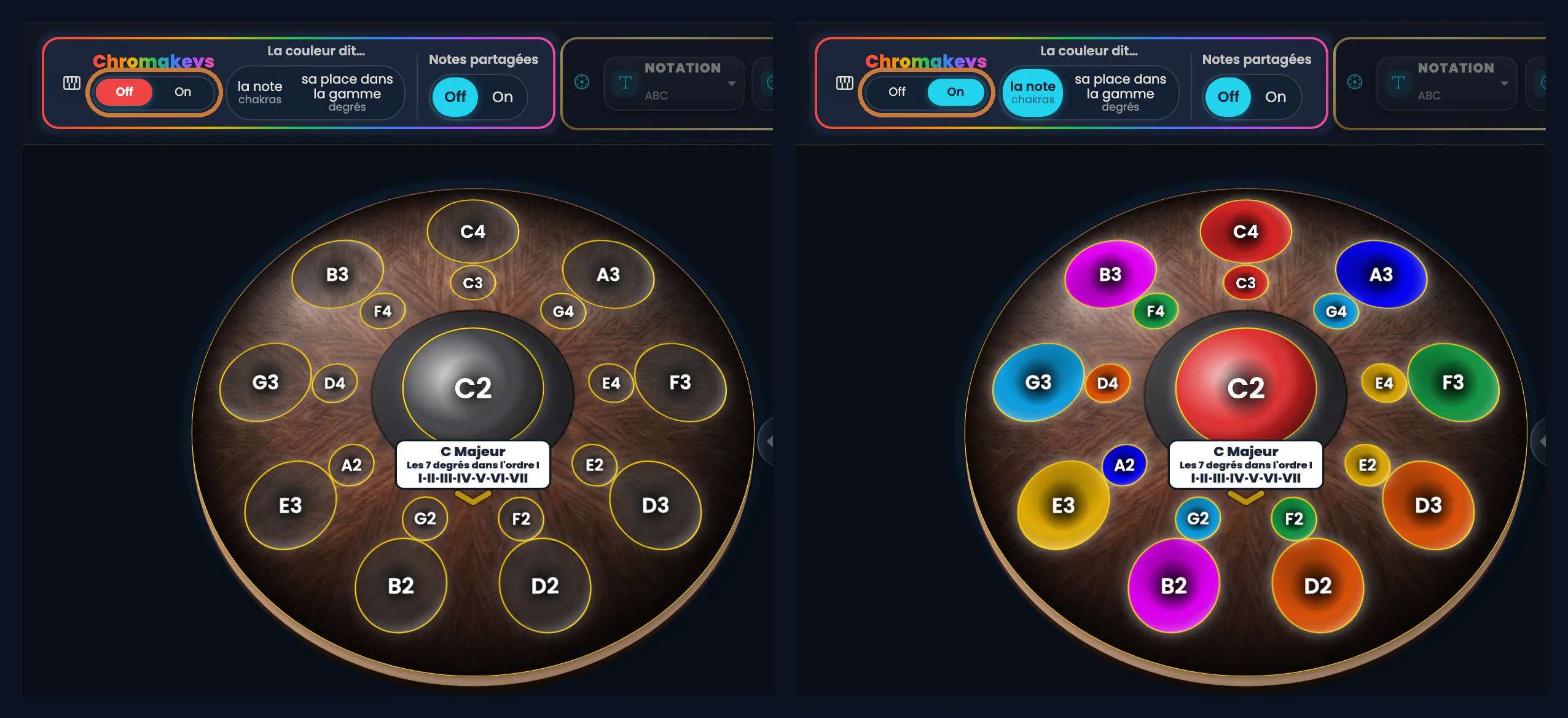
Two captures side by side of the same 19-note Neotone Mutant, in Logic mode anchored in C major, same framing, with the Chromakeys island above. A copper ring circles the Off/On switch on each half. Left, Off: the nineteen notes without colour, only their outline and their name on the wood. Right, On: each note takes back the colour of its name, the Cs red, the Ds orange, the Es yellow, the Fs green, the Gs sky blue, the As indigo, the Bs magenta.
The same test on the electronic pan: on Off, nineteen notes without colour; on On, each takes back the colour of its note. (Screenshot of the French interface.)

Click the image to open it, then click again for full size.

On an eighteen-note pan, the difference is even more striking.
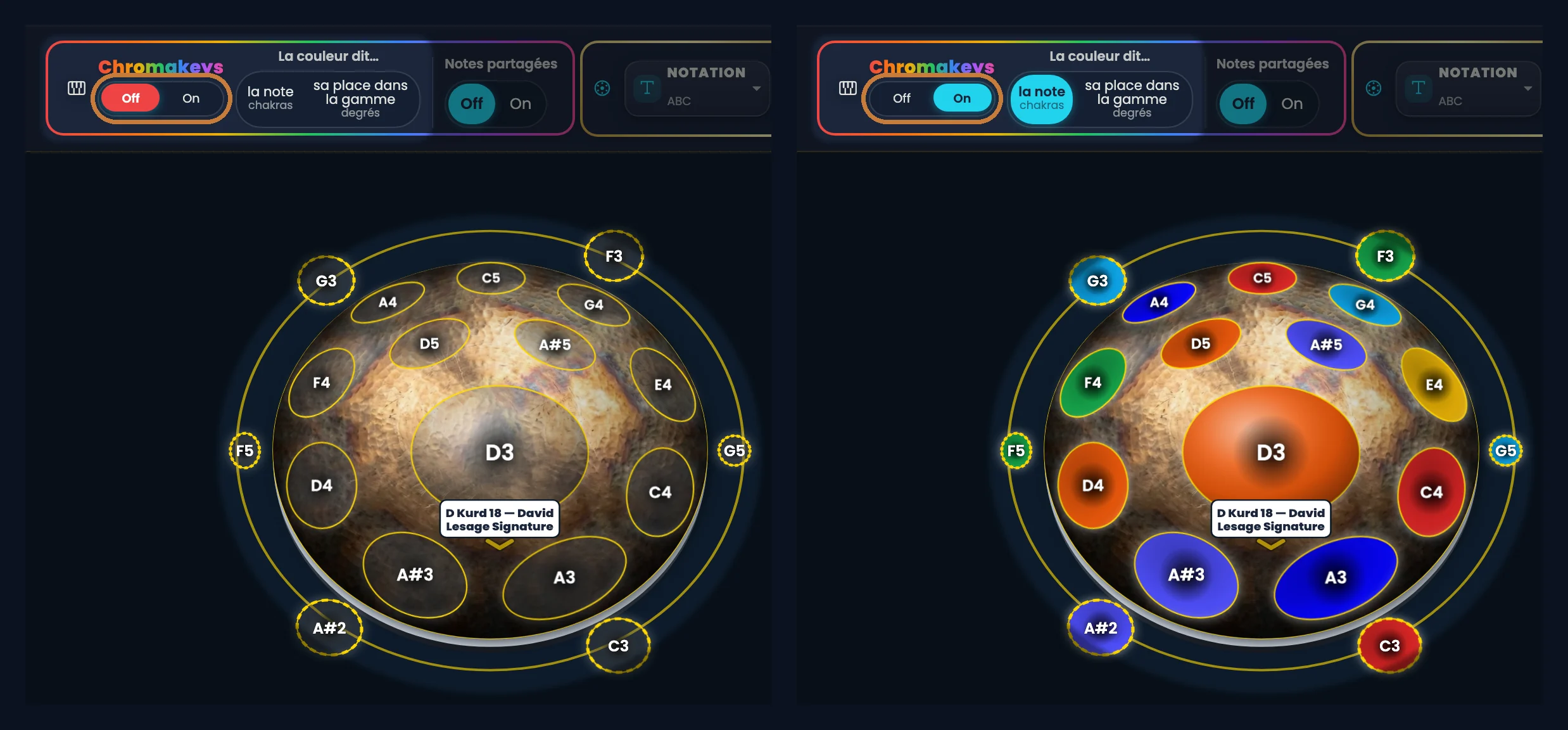
ChromaKeys OffChromaKeys On
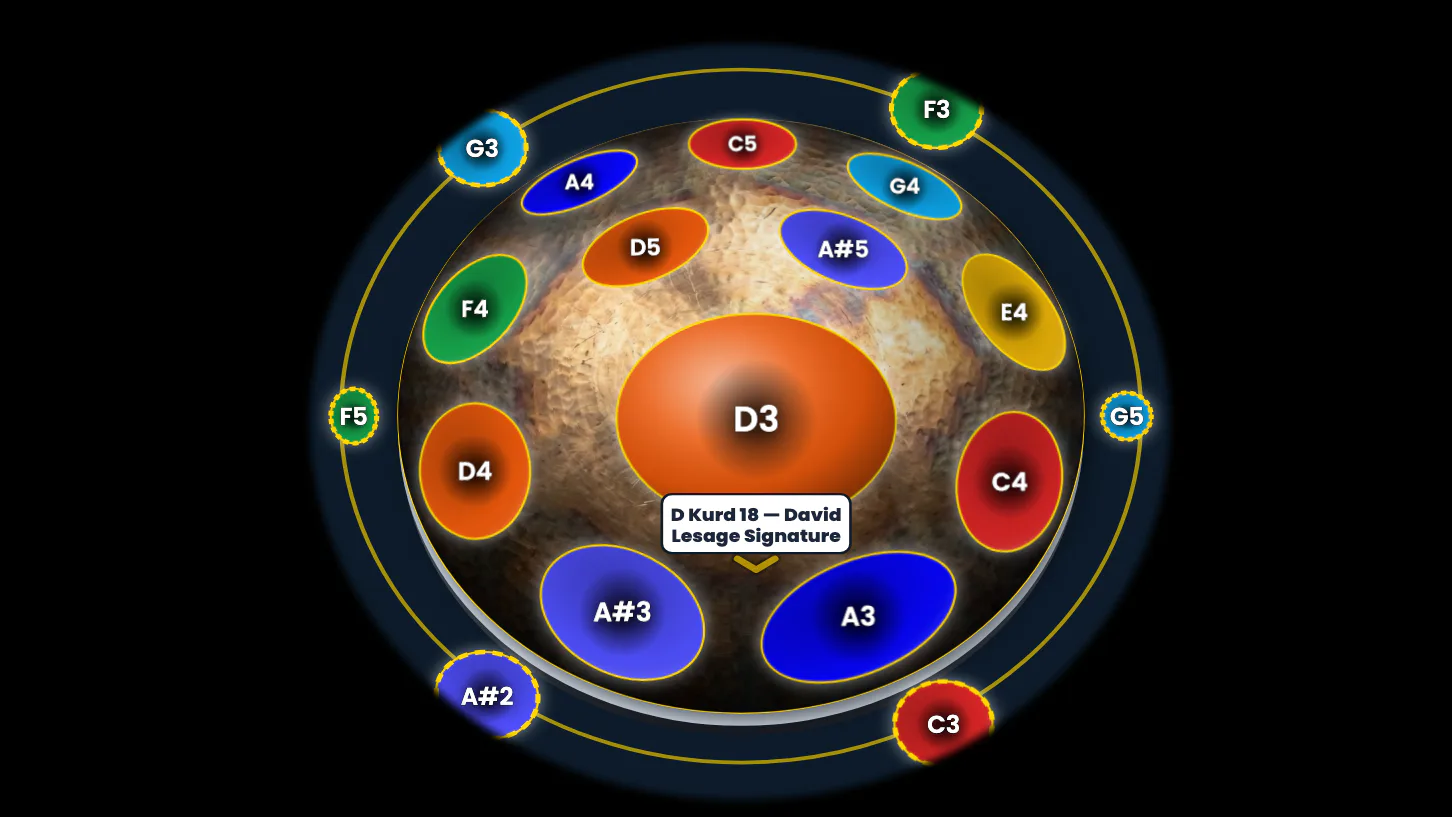
Two captures side by side of the same acoustic “D Kurd 18 — David Lesage Signature” handpan, same framing, with the Chromakeys island above. A copper ring circles the Off/On switch on each half. Left, Off: twelve notes on top and six bottom notes all around, all without colour. Right, On, the colour says “the note”: the Ds orange, the As and A sharps indigo, the Cs red, the Fs green, the Gs sky blue, the E yellow.
My D Kurd 18, Off then On: eighteen grey notes blur together, eighteen coloured notes sort themselves into families. (Screenshot of the French interface.)

Click the image to open it, then click again for full size.

The ChromaKeys menu: three questions, not one

At the top of the screen, the toolbar. Inside it, an island with a multicoloured outline: ChromaKeys. It asks two questions, and a third one is set elsewhere, on the chord cards. All three are independent: you can answer one without touching the other two.

  1. Colour says… → the note · its place in the scale. For it to say nothing, you don’t need a third choice: that’s the Off switch under the ChromaKeys name. Switch back to On, and the last reading you chose comes back.
  2. Shared notes → Off / On
  3. Chord drawing → there’s nothing to click here: the eye lives on each chord card, at the bottom of the screen, not in the island.

You’ll notice that the two choices of “Colour says…” each carry two labels: the plain word first, and the theory word in small type right beside it. The note is what others call the chakras. Its place in the scale is what’s called the scale degrees. I say it once here, and after that I use the plain words.

”Colour says the note”: a C always red

First possible answer. Here the colour is glued to the name of the note, and it never moves again.

  • A C is red.
  • A D is orange.
  • An F is green.
  • An A is indigo.

All twelve notes have their colour — sharps included, each with its own shade. Change scale, change instrument, change key: nothing moves. Red stays C.
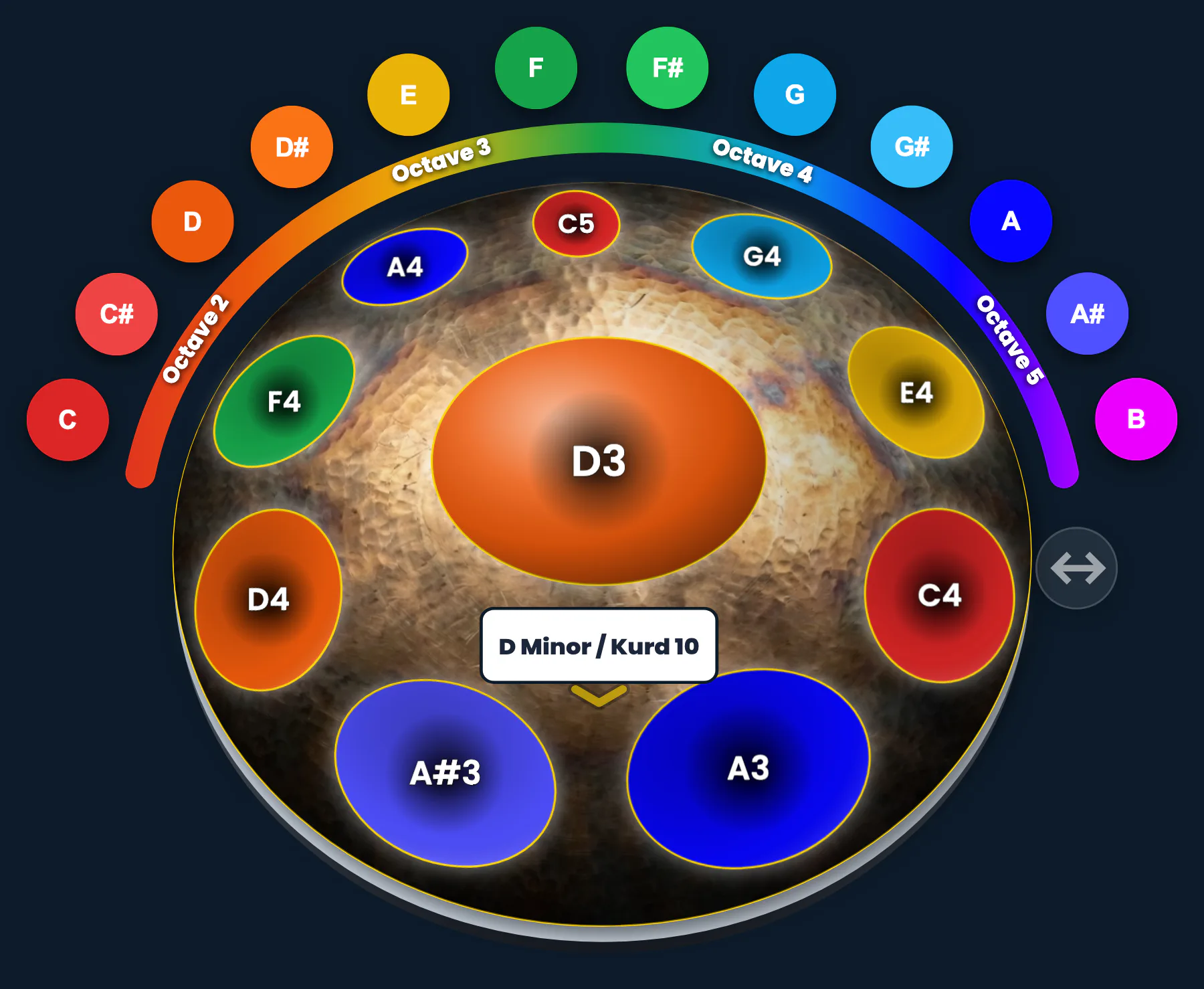
The ChromaKeys creation palette: an arc of twelve round dots above the acoustic D Minor / Kurd 10 handpan. From left to right: C dark red, C sharp bright red, D dark orange, D sharp light orange, E yellow, F dark green, F sharp light green, G sky blue, G sharp light sky blue, A indigo, A sharp light indigo, B magenta. Under the arc, a curved band runs from red to violet and carries the marks Octave 2, Octave 3, Octave 4, Octave 5.
The twelve colours, in order. The seven notes, and between them the semitones in a lighter shade of the same colour: that's the only thing to remember.

Click the image to open it, then click again for full size.

The most immediate benefit is the octave.

With nothing else turned on, every D on your shell is orange: the low one, the high one, the one up on the right. At a glance, you see they are the same note at different pitches.

That’s the kind of thing that takes months to absorb by ear, and becomes obvious in a second through colour.
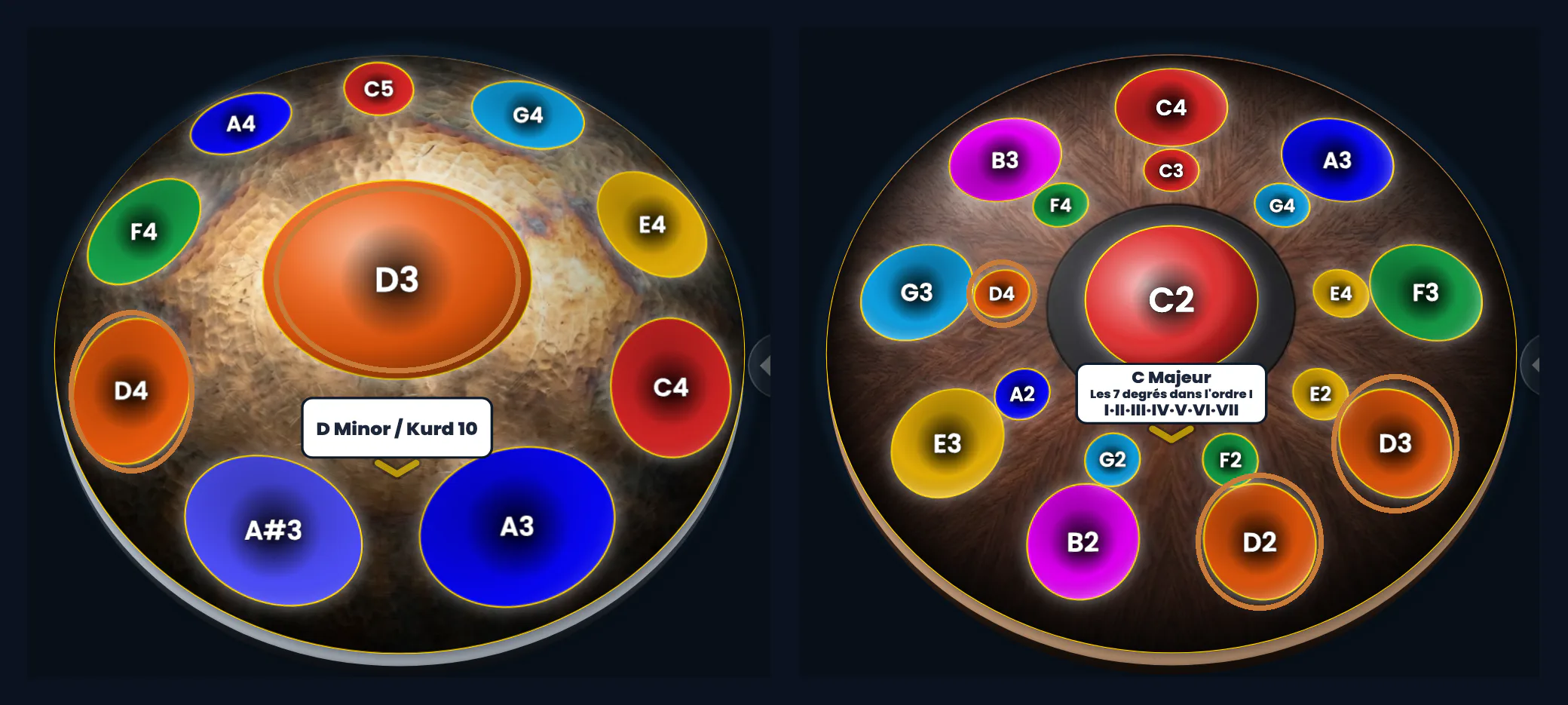
Acoustic · D Kurd 10Electronic · Neotone Mutant
Two pans side by side, colour set to “the note”. On the left, the acoustic D Minor / Kurd 10 handpan: a copper ring circles the D3 ding and D4, in the same orange. On the right, the Neotone Mutant anchored in C major: a copper ring circles D2, D3 and D4, also in the same orange. The other notes keep the colour of their name: Cs red, Es yellow, Fs green, Gs sky blue, As indigo, Bs magenta.
The Ds are the same orange, circled in copper: the D3 ding and D4 on the acoustic pan, D2, D3 and D4 on the electronic pan. The octave becomes visible before it becomes audible. Same for the As and the Cs. (Screenshots of the French interface.)

Click the image to open it, then click again for full size.

What is a scale degree?

Before the second answer, one word is needed. Just one.

A scale is seven places, from the first to the seventh. Like the steps of a staircase.

Each note of your scale sits on one step, and only one. The degree of a note is the number of its step. Nothing more.

What’s lovely is that the steps have a character — always the same one, in any key. I gave them names:

  • I — Balance: home, where everything settles.
  • II — Momentum: it starts, it pushes gently.
  • III — Adventure: you leave the known behind.
  • IV — Relaxation: you breathe.
  • V — Tension: it pulls, it asks for what comes next.
  • VI — Nostalgia: sweetness with a sting.
  • VII — Mystery: suspended, it can’t stay there.

Each one also has its vowel, to sing: OU · O (as in “beau”) · O (as in “or”) · A · E · I · M. That’s the bridge to singing, and it’s worked on in Sing & Play mode — a subject of its own.

”Colour says its place in the scale”

Second answer. Here the colour no longer looks at the note’s name: it looks at the chord it serves in your scale.

On an electronic handpan, in Logic mode, this colour is the colour of the chord’s degree. The I chord is always red, the II orange, and so on. If your scale is in D, it’s the notes of the D chord that turn red. Colour follows the place, not the name.

A visible consequence: two notes with the same name can carry two different colours, because they don’t serve the same chord.

And the pattern of the seven colours stays identical from one key to another: that’s what lets you play the same thing elsewhere without relearning anything.

Outside Logic mode — in Scales, in My instrument, and always on an acoustic handpan — the button keeps the same name, but each chord takes the colour of the note it is named after. You still see at a glance which notes go together, but it is no longer the reading by degrees.

On the D Kurd in the screenshots below, F4 and A4 take on D’s orange: they aren’t Ds, but they belong to the D chord.

The two readings, side by side

Here is the same handpan, photographed twice: on the left the colour says the note, on the right its place in the scale. Nothing else has moved.
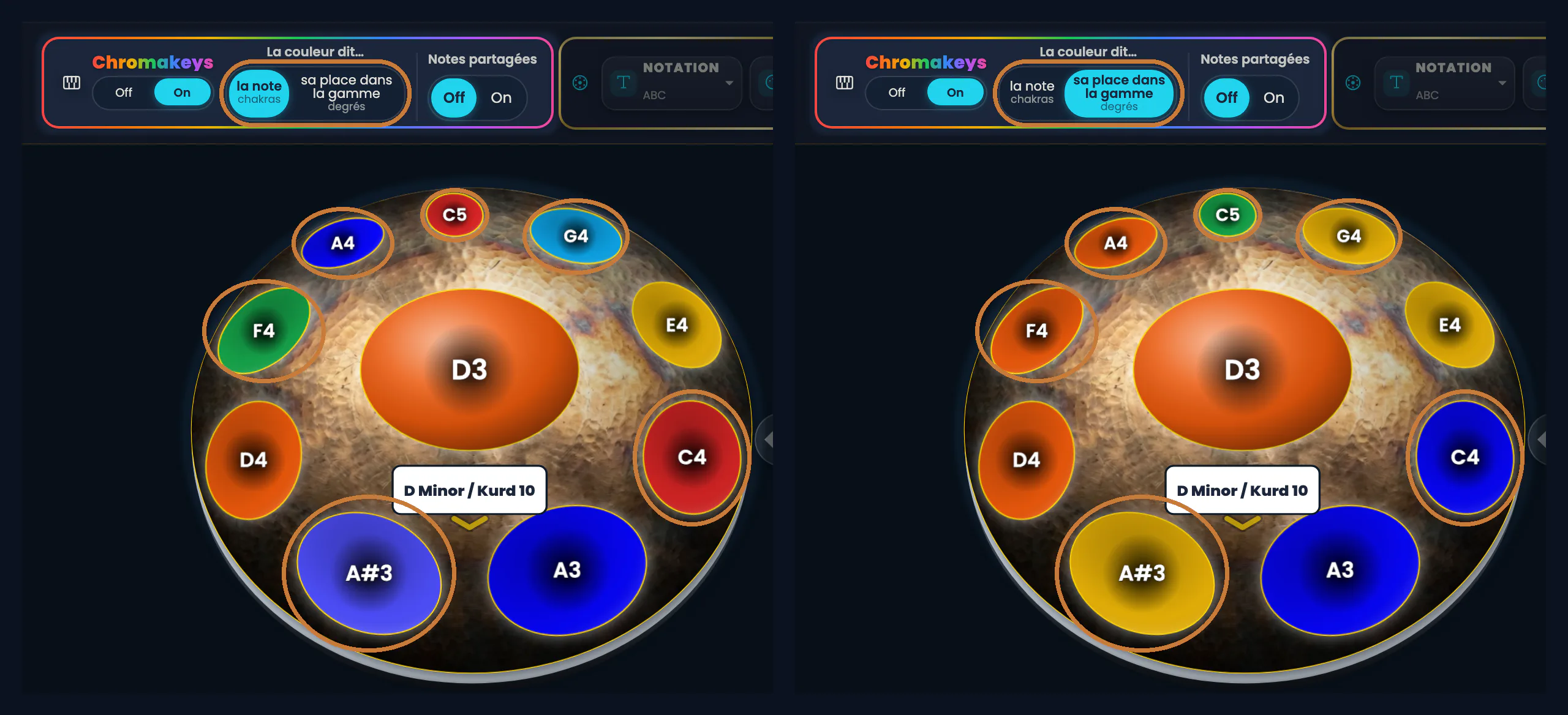
Colour says: the noteColour says: its place in the scale
Two captures side by side of the same acoustic D Minor / Kurd 10 handpan, same framing, outside Logic mode. On each half, a copper ring circles the “Colour says…” setting and six notes. Left, “the note”: F4 green, A4 indigo, C5 red, A#3 light indigo, G4 sky blue, C4 red. Right, “its place in the scale”: F4 and A4 orange, C5 green, A#3 and G4 yellow, C4 indigo. D3, D4, E4 and A3 don't change.
The same acoustic handpan, twice, outside Logic mode. Six notes change colour, circled in copper: F4 and A4 turn to the orange of the D chord, C5 to the green of the F chord, A#3 and G4 to the yellow of the E chord, C4 to the indigo of the A chord. (Screenshot of the French interface.)

Click the image to open it, then click again for full size.
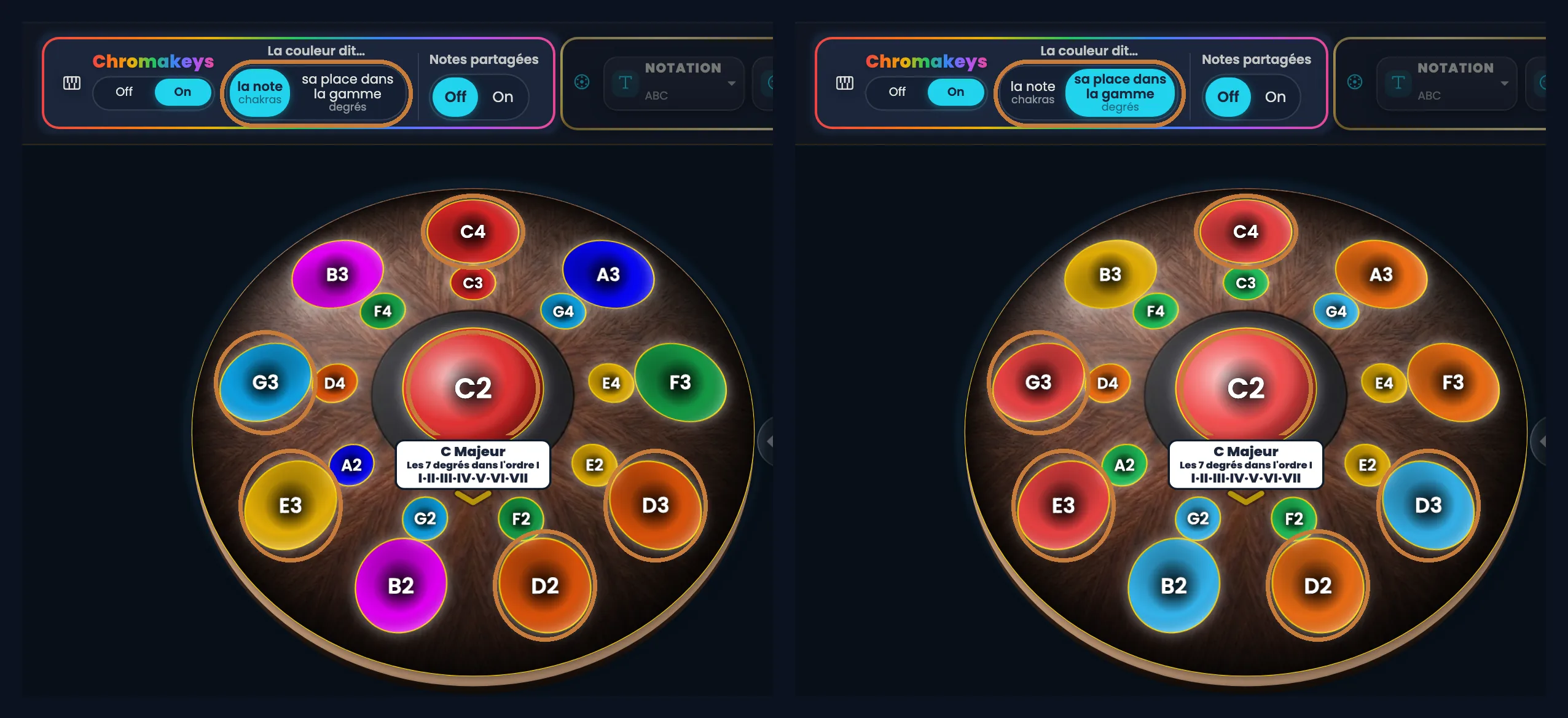
Colour says: the noteColour says: its place in the scale
Two captures side by side of the same Neotone Mutant, in Logic mode anchored in C major, same framing. On each half, a copper ring circles the “Colour says…” setting and six notes: C2, E3, G3, C4, D2 and D3. Left, “the note”: C2 and C4 red, E3 yellow, G3 sky blue, D2 and D3 orange. Right, “its place in the scale”: C2, E3, G3 and C4 all red, D2 orange, D3 sky blue.
The same electronic pan, twice, in Logic mode. On the right, the notes of the I chord (C2, E3, G3, C4, circled) are all red; D2 is orange (II), but D3 is sky blue because it serves the V chord. (Screenshot of the French interface.)

Click the image to open it, then click again for full size.

When there are a lot of notes

Ten notes, you can remember. But my stage handpan has eighteen. Here are the two readings you’ve just seen, on that big instrument.

When the brain has a lot of information to handle at once, it stops sorting: it just takes the hit. Colour does the sorting for it.
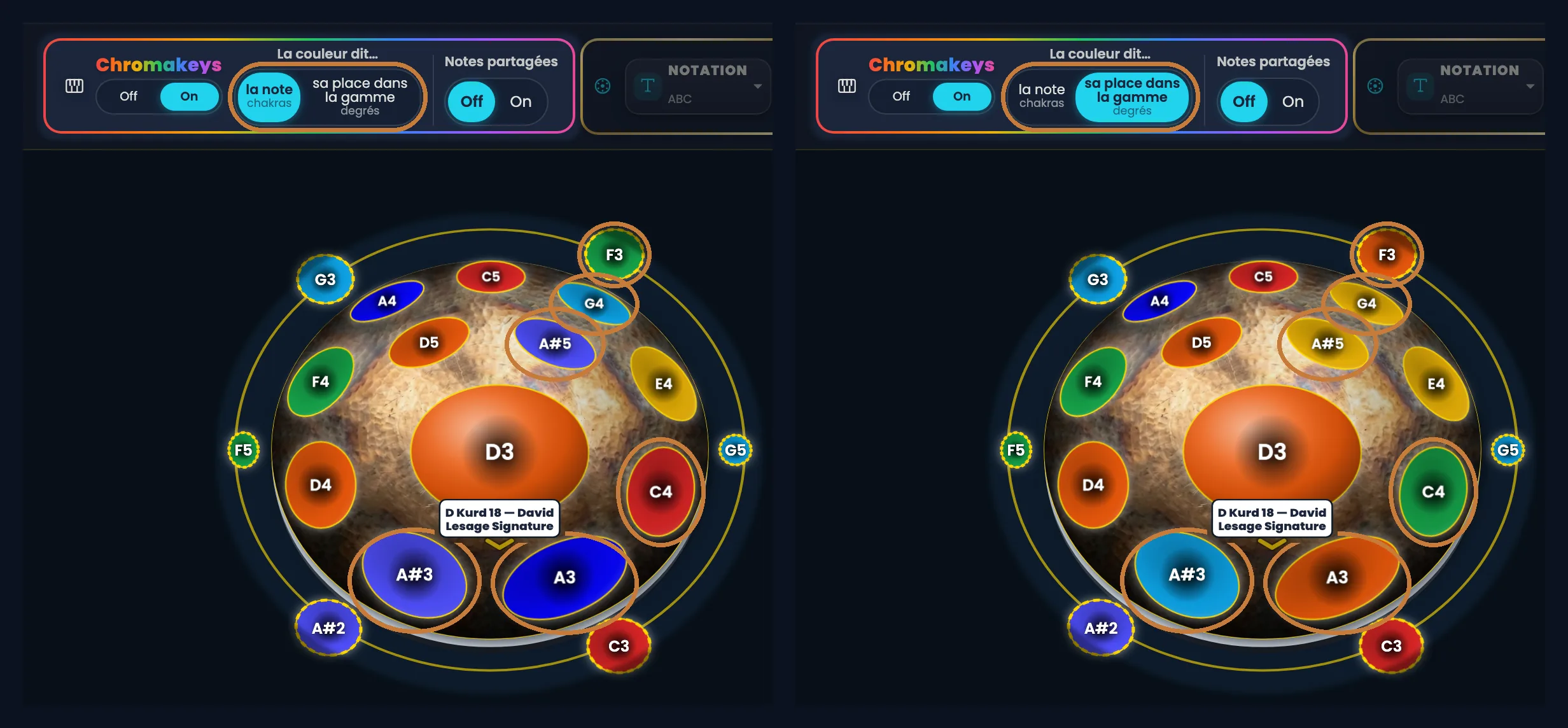
Colour says: the noteColour says: its place in the scale
Two captures side by side of the same acoustic “D Kurd 18 — David Lesage Signature” handpan, same framing. On each half, a copper ring circles the “Colour says…” setting and six notes: A3, A#3, C4, G4, A#5 and F3. Left, “the note”: A3 indigo, A#3 and A#5 light indigo, C4 red, G4 sky blue, F3 green. Right, “its place in the scale”: A3 and F3 orange, A#3 sky blue, C4 green, G4 and A#5 yellow.
My D Kurd 18, twice. On the left, each note has the colour of its name; on the right, the colour of the chord it serves. Six notes change, circled in copper — watch C4 turn green and A3 turn orange. It's the same instrument: only the way of reading it has changed. (Screenshot of the French interface.)

Click the image to open it, then click again for full size.

”Shared notes”: when one note serves several chords

Third idea, and it’s a setting of its own.

One and the same note can belong to several chords.

When Shared notes is On, that note splits into slices — a pie, one slice per chord it takes part in, each slice in the colour of the chord concerned.

When the colour says the note, sharing takes another form: a thin ring around the note’s colour, which keeps the note recognisable.

Three things to know:

  • On an acoustic D Kurd 10, eight notes out of ten split. That isn’t a textbook case: that’s nearly your whole shell.
  • In Logic mode too, on a Neotone Mutant in C major, many notes are split: the seven degrees share notes.
  • The slices disappear as soon as a chord eye is opened. The two never coexist on screen: either you look at the network of shared notes, or you look at a drawn chord.
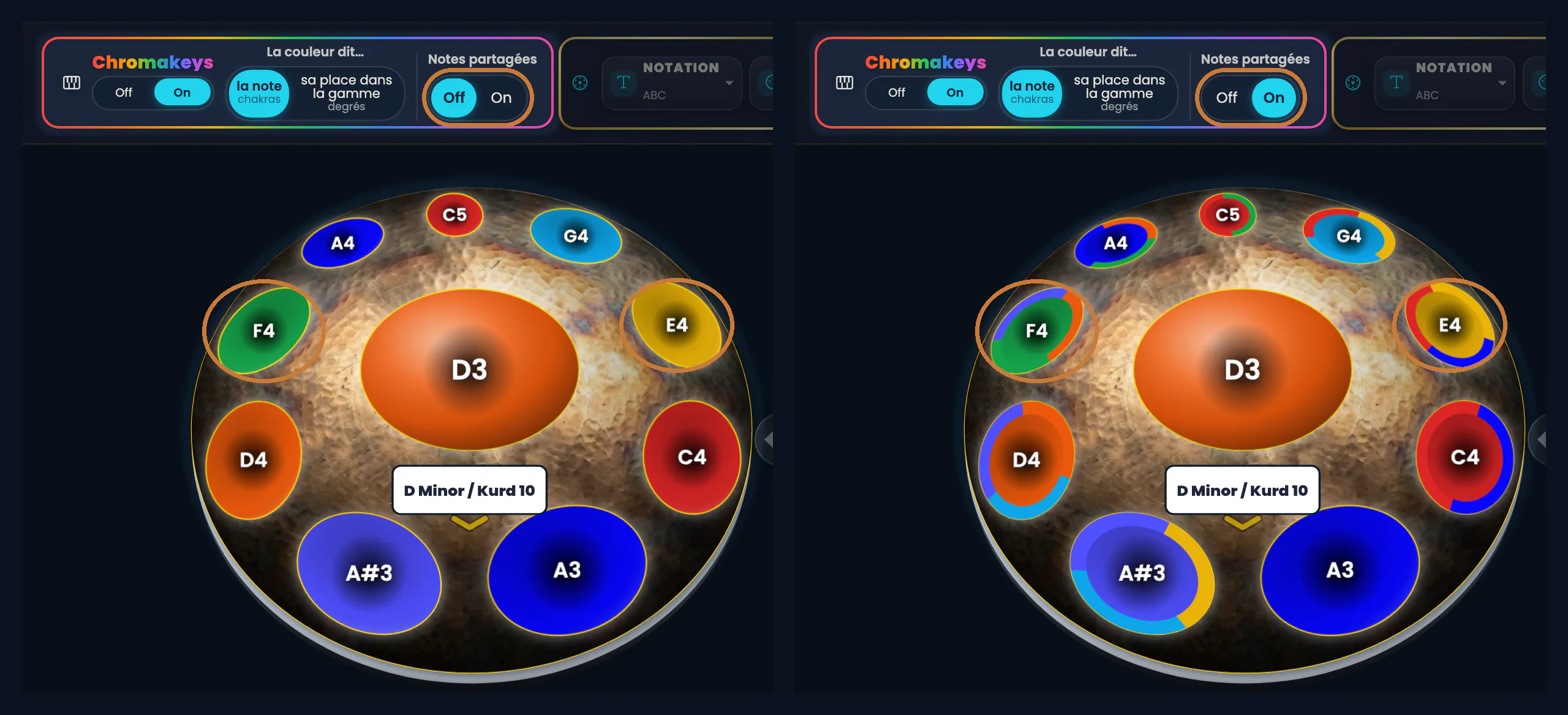
Shared notes: OffShared notes: On
Two captures side by side of the same acoustic D Minor / Kurd 10 handpan, colour set to “the note”. On each half, a copper ring circles the “Shared notes” setting as well as F4 and E4. Left, Off, each note has a single colour. Right, On, a ring of colours appears around most notes: F4 and E4 carry three arcs each; the D3 ding and A3 stay without a ring.
Shared notes, on the same acoustic pan: off on the left, on on the right. Each arc of the ring names a chord the note belongs to: look for example at F4 and E4, three arcs each (circled). Only the ding and A3 stay bare. (Screenshot of the French interface.)

Click the image to open it, then click again for full size.
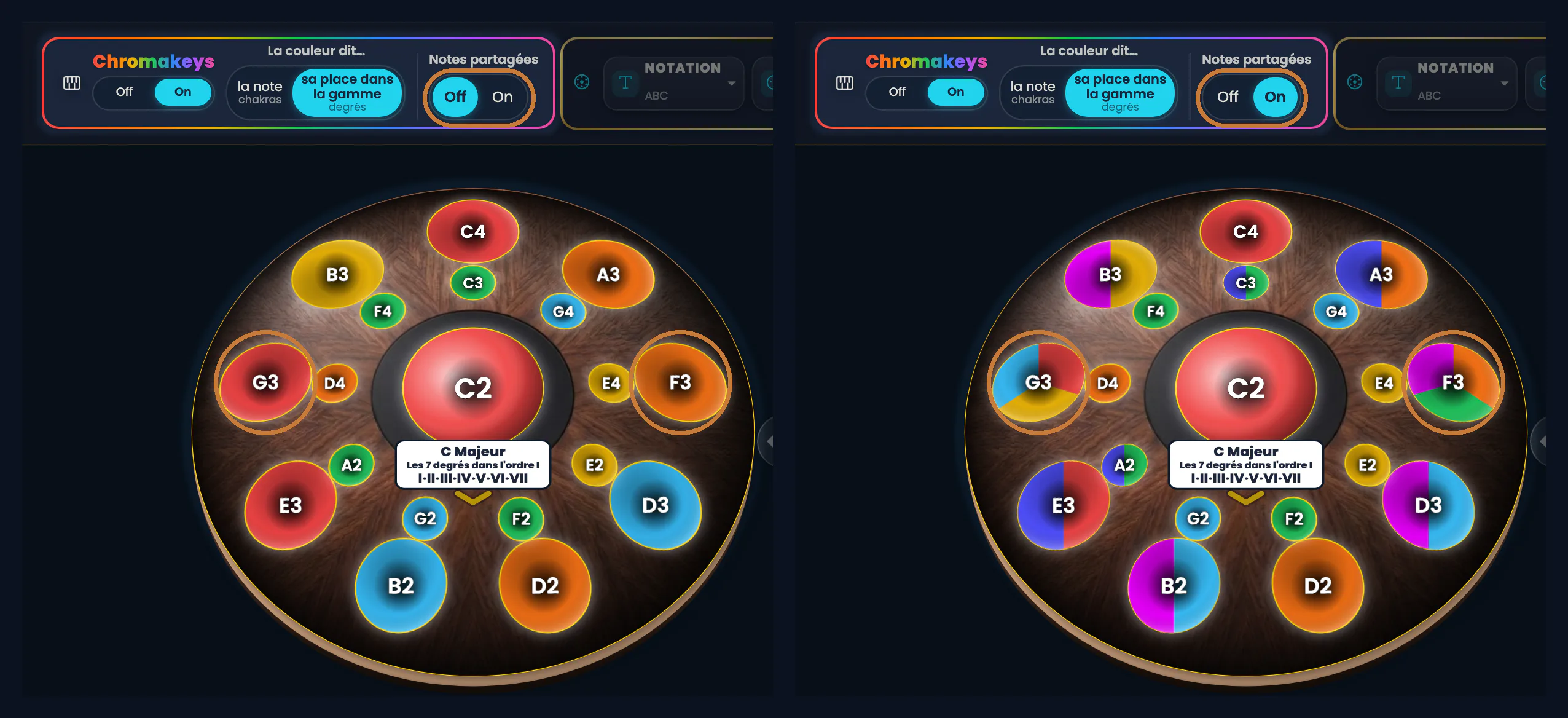
Shared notes: OffShared notes: On
Two captures side by side of the same Neotone Mutant, in Logic mode anchored in C major, colour set to “its place in the scale”. On each half, a copper ring circles the “Shared notes” setting as well as G3 and F3. Left, Off, each note has a single colour. Right, On, G3 and F3 are cut into three slices; E3, B3, D3, B2, A3, C3 and A2 into two.
The same test on the electronic pan. Here too notes are shared: G3 and F3 in three slices (circled); E3, B3, D3, B2, A3, C3 and A2 in two. (Screenshot of the French interface.)

Click the image to open it, then click again for full size.

”Chord drawing”: the eye that traces the constellation

On each chord card, at the bottom of the screen, there’s an eye.

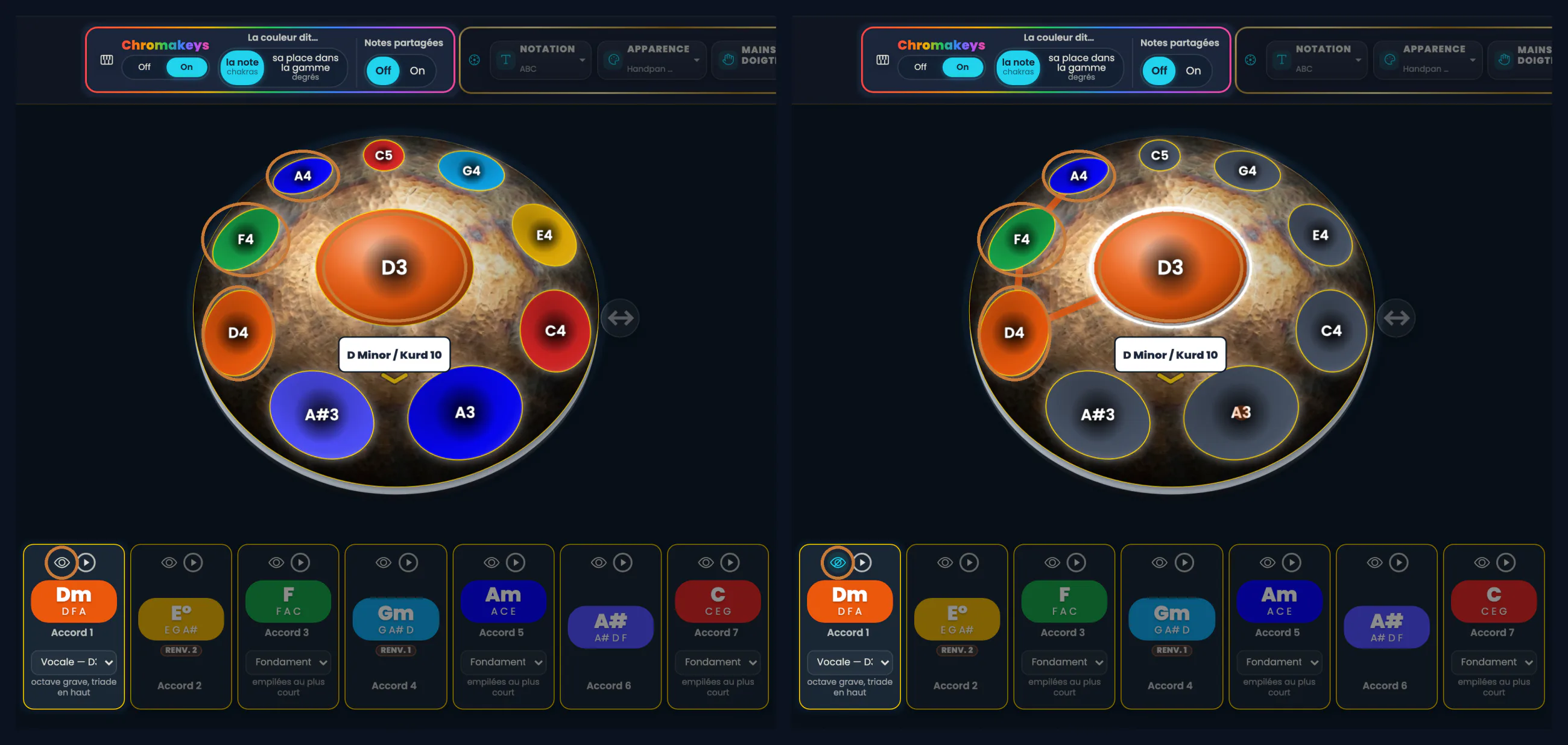
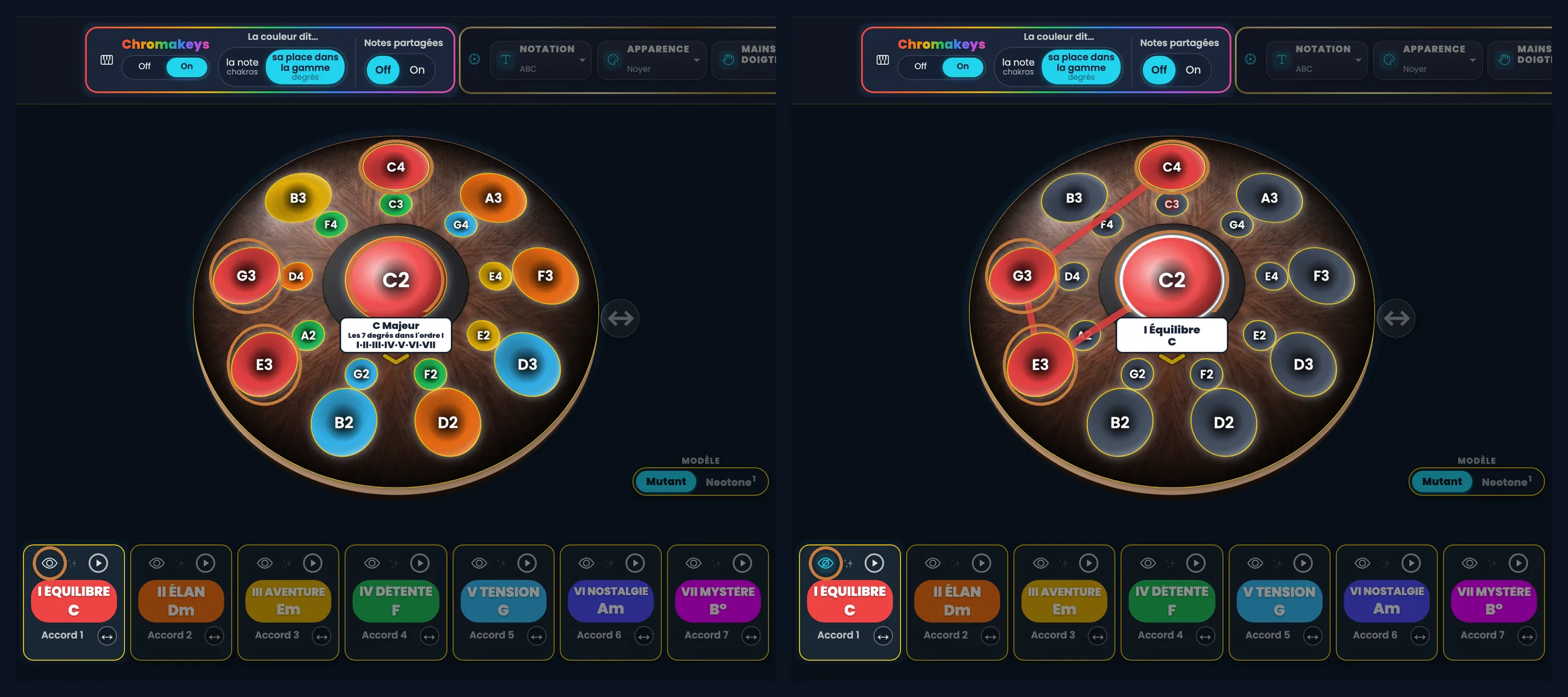
You open it, and the chord’s constellation is traced on the instrument: a path linking its notes together.

That drawing is what stays the same when you change key — and that’s where Logic mode becomes a machine for understanding.

What you see depends on your answer to the first question:

  • With “its place in the scale”: the whole chord takes the colour of its degree — the I entirely red — and the rest of the instrument dims to grey.
  • With “the note”: the constellation is traced just the same, but each note keeps its own colour. The rest dims too.

Two ways of looking at the same chord: its function on one side, its geography on the other.
Eye closedEye open
Two captures side by side of the same acoustic D Minor / Kurd 10 handpan, with the Chromakeys island at the top and the chord cards at the bottom. On each half, a copper ring circles the eye of the Accord 1 (Dm) card and the four notes of the chord: D3, D4, F4 and A4. Left, the eye is closed: every note has its colour. Right, it is open: an orange path joins D3, D4, F4 and A4, and the other notes turn grey.
The eye of the Accord 1 (Dm) card, circled in copper: closed on the left, open on the right. The constellation is traced between D3, D4, F4 and A4, and the rest of the instrument dims to grey. (Screenshot of the French interface.)

Click the image to open it, then click again for full size.
Eye closedEye open
Two captures side by side of the same Neotone Mutant, in Logic mode anchored in C major, colour set to “its place in the scale”, with the Chromakeys island at the top and the seven chord cards at the bottom. On each half, a copper ring circles the eye of the I Équilibre (C) card and the notes C2, E3, G3 and C4. Left, the eye is closed. Right, it is open: a red path joins C2, E3, G3 and C4, all red, and the other notes turn grey.
The same gesture on the electronic pan: the whole chord is red (C2, E3, G3, C4), because it is the I. Shape and colour say the same thing. (Screenshot of the French interface.)

Click the image to open it, then click again for full size.

You have nothing to set: the presets by level

If all that sounds like a lot, good news: you have nothing to do. Your level answers for you, and you can always come back to it later.

LevelColour says…Shared notes
Discoverythe noteOff
Apprenticeits place in the scaleOn
Musicianeverything visible and adjustableyour choice

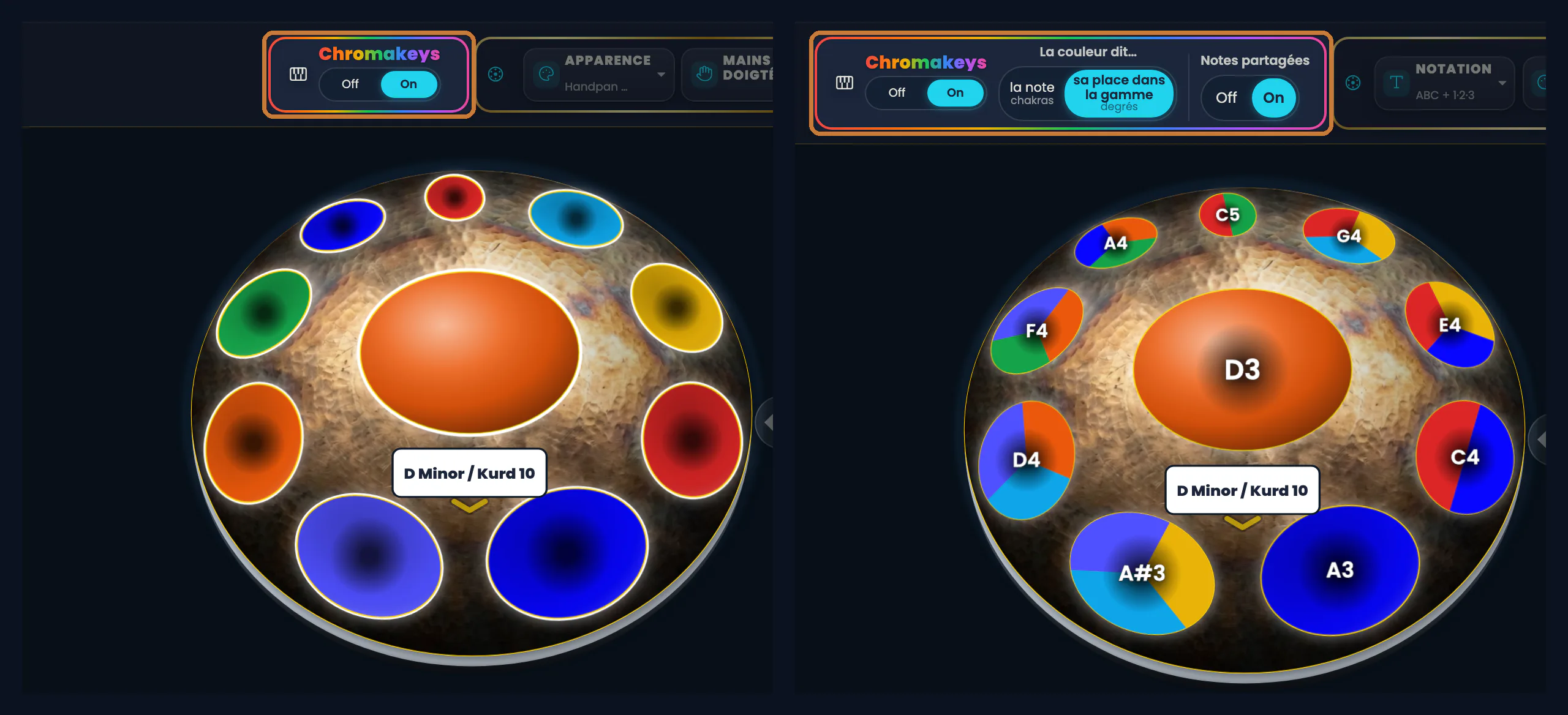
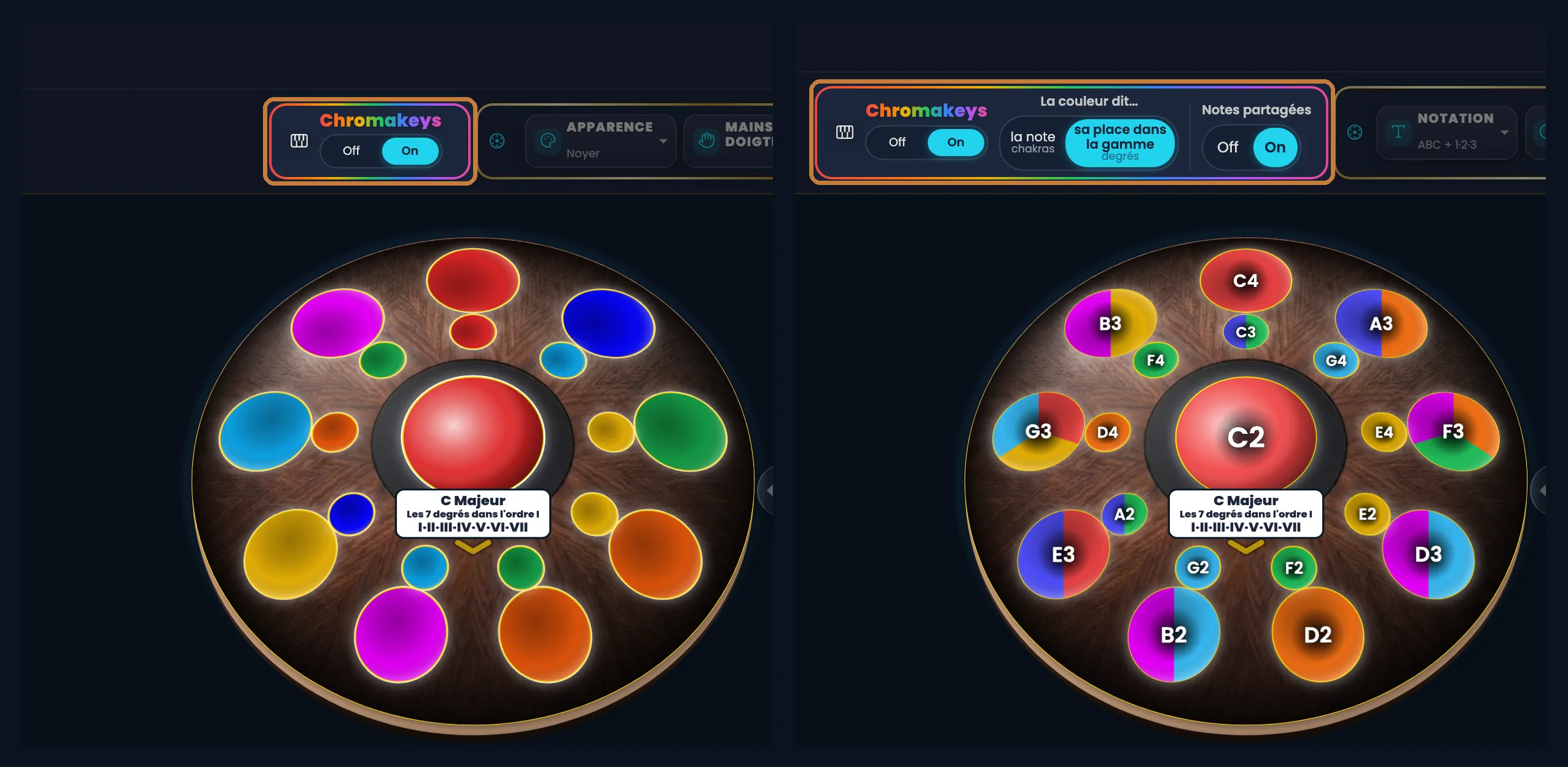
In Discovery, the island shrinks to the essentials: a single switch, Off or On. The other two settings are put away: you can’t knock them out of place by accident, and they come back at Apprentice level.
Discovery levelApprentice level
Two captures side by side of the same acoustic D Minor / Kurd 10 handpan. On each half, a copper ring circles the Chromakeys island. Left, at Discovery level, the island holds only an Off/On switch and the note names are hidden; each note carries the colour of its name. Right, at Apprentice level, the island shows “Colour says…” on “its place in the scale” and “Shared notes” On: the note names are shown and several notes are cut into coloured slices.
The same D Kurd 10, two levels. At Discovery, the island shrinks to a single switch, Off or On. At Apprentice, the settings come back, already set: place in the scale, and shared notes on. (Screenshot of the French interface.)

Click the image to open it, then click again for full size.
Discovery levelApprentice level
Two captures side by side of the same Neotone Mutant, in Logic mode anchored in C major. On each half, a copper ring circles the Chromakeys island. Left, at Discovery level: a single Off/On switch, note names hidden, each note in the colour of its name. Right, at Apprentice level: “its place in the scale” and “Shared notes” On, names shown, several notes cut into two or three slices.
The same pair on the electronic pan: a single switch at Discovery, the settings already set at Apprentice. (Screenshot of the French interface.)

Click the image to open it, then click again for full size.

And next

Once you read the colours by place in the scale, something unexpected happens: the drawing of each chord no longer depends on the key. The I has the same shape in C, in D, in A. It is exactly the gesture of a guitarist putting on a capo — except that on an electronic handpan, the capo is a button. That’s the subject of the next article: The handpan capo.

The words don’t change from one instrument to the other — acoustic or electronic, it’s the same screen, the same three questions. That’s the point.

Ready to make your colours sing?

Try the app for free, or discover the electronic Neotone handpan.