The three faces of minor: natural, harmonic, melodic
Under Logic Mode's "Sad" button, three shades of minor. Two dots rise by a semitone, and the oriental or jazz colour appears.
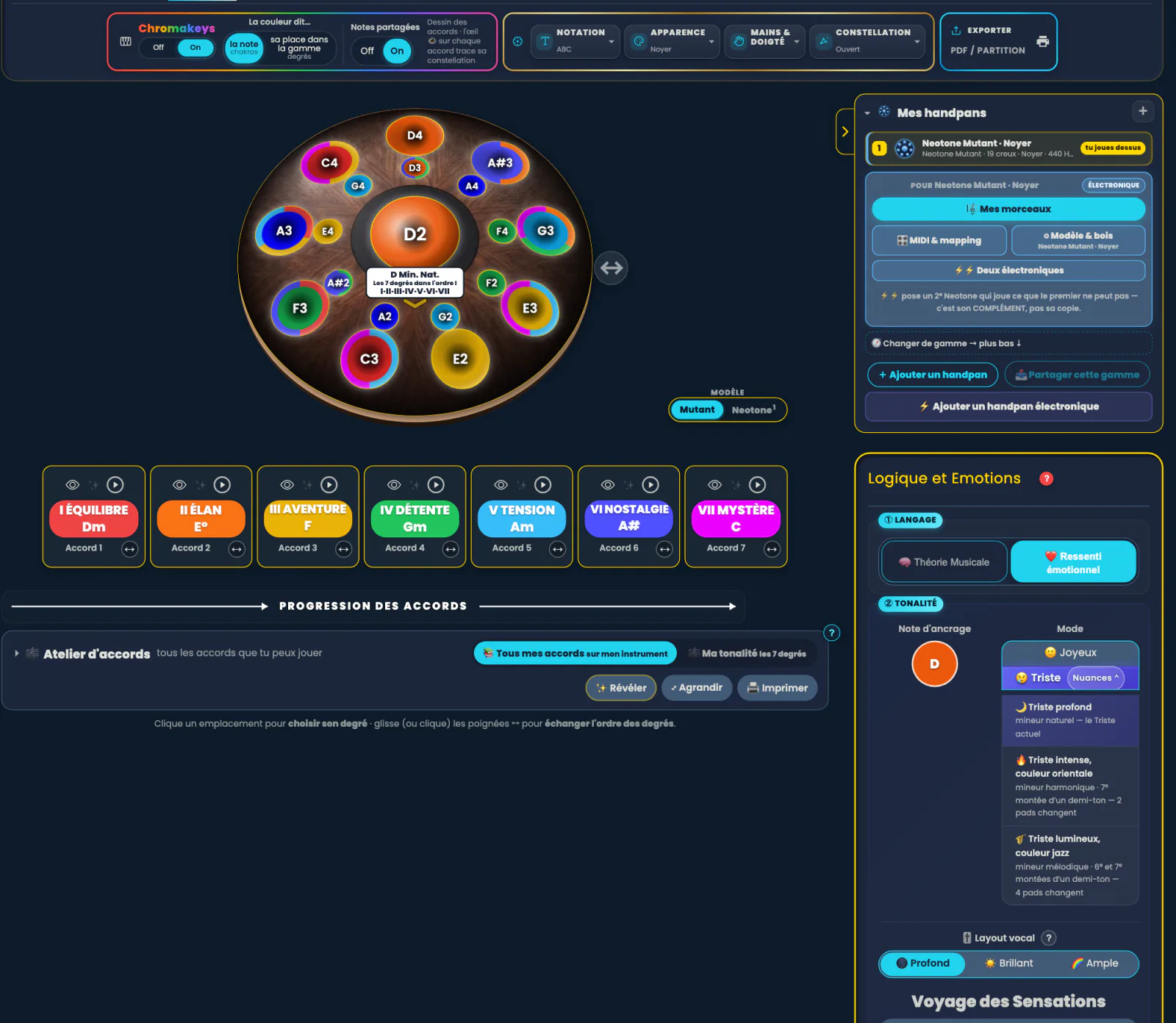
“Sad” (Triste), in Handpan Constellation Studio’s Logic Mode, is no longer a single colour. That button now hides three shades of minor — natural 🌙, harmonic 🔥, melodic 🎷 — and it only takes two or four notes rising by a semitone to move from one to the next. The chord shapes themselves don’t budge.
This article is about the electronic handpan: raising a note by a semitone requires pads. What the app keeps of it on the acoustic side is stated at the end of the article.
Minor isn’t an emotion, it’s a family
We learn very early that major = happy and minor = sad. It’s convenient, and it falls apart the moment you actually listen. A lullaby, an oriental theme and a jazz standard can all three be “in minor” and tell completely different stories.
The difference comes down to almost nothing: depending on whether the sixth and the seventh of the scale rise by a semitone, the same key changes face. Three scales, three atmospheres.
🌙 Natural minor — the “deep sad”
This is the one everyone knows, and the one your handpan plays by default. Its degrees are figured i, ii°, III, iv, v, VI, VII: the fifth degree is minor, which gives that gentleness that never quite concludes. It’s the colour of drones, of contemplation, of the handpan as people imagine it.
Click the image to open it, then click again for full size.
🔥 Harmonic minor — the oriental colour
Raise the seventh by a semitone and everything shifts. The fifth degree becomes a true major dominant: it pulls towards the tonic instead of floating. Between the sixth and seventh degrees a wider interval opens up — that unmistakable oriental step.
On the pan, only two dots change note.
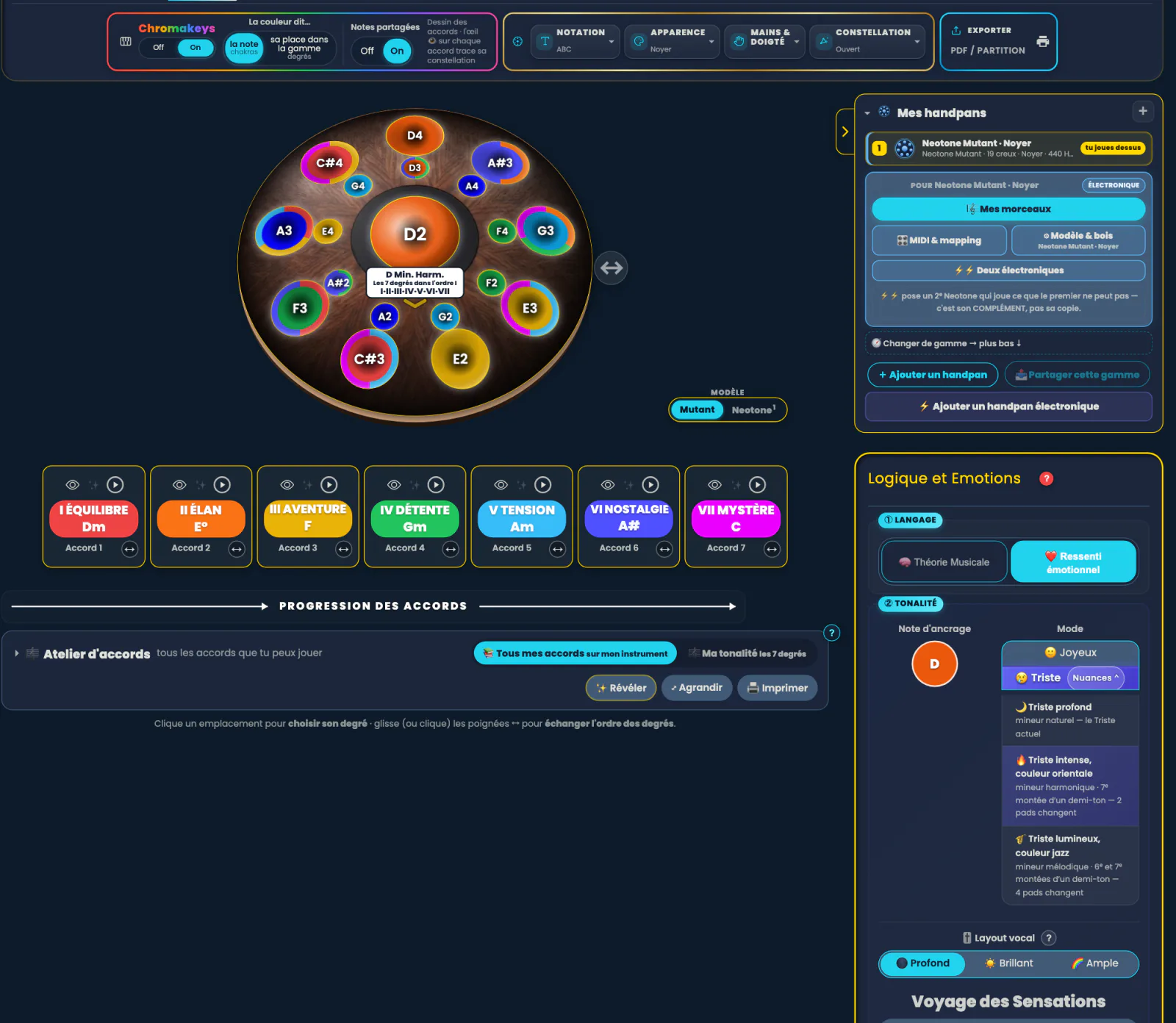
Click the image to open it, then click again for full size.
🎷 Melodic minor — the jazz colour
Raise the sixth and the seventh, and you get the jazz musicians’ scale. The fourth degree turns major, the ii-V-i becomes playable, and the melancholy takes on an elegant, almost smiling quality.
On the pan, four dots change note.
What doesn’t change: your hands
Here’s the point that makes all this approachable, and it’s the heart of the method. The chord shapes and the fingerings stay identical. Same slots, same paths, same play order, same left hand and same right hand. Only the pitch of two or four dots moves by a semitone.
In other words, you relearn nothing. You play exactly the same gesture, and you hear a different musical culture come out of your instrument. It’s the kind of thing that takes years to grasp through music theory, and becomes obvious when the colour stays stable while the sound changes.
Where it lives, and for whom
The shades live in a small menu that unfolds under the Sad button, at Musician level; at Discovery and Apprentice levels a ✨ badge simply signals they exist without cluttering the screen. Your choice is remembered and applies whenever you go back to Sad — in Happy it’s simply ignored.
One important, deliberate caveat: it’s for the electronic handpan only. On an acoustic handpan the notes are physically hammered into steel; no app will raise a pad by a semitone. You need a Neotone to hear the shade change under your hands. In acoustic mode the app keeps showing correct degrees in all four frames — major, natural minor, harmonic and melodic minor — but it does not raise any note: it describes what your instrument can do, without promising the impossible.
Open Handpan Constellation Studio, switch to Sad, and slide the minor from one face to another. You’ll hear three musics inside a single instrument. And if you’d like to understand what you’re hearing, my handpan lessons explain it all without music theory.
Ready to make your colours sing?
Try the app for free, or discover the electronic Neotone handpan.