Neotone with 10 notes or 19 notes: which one should you choose?
The 10-note Neotone¹ and the 19-note Neotone¹ Mutant don't serve the same project. Main instrument, voice, or a complement to your acoustic handpan: the cases where one or the other is the right choice.

This article is about the Neotone electronic handpan. It comes in two models: the Neotone¹, with 10 notes, and the Neotone¹ Mutant, with 19 notes. Neither is “better”: each one answers a different project.
The difference in one image

Click an image to open it, then click it again for full size.
The Mutant also has a small built-in screen on the instrument. The 10-note Neotone¹ does not.
Choose the 19 notes if…
You want to make it your main instrument
With 19 notes, you’re no longer locked into a single colour of music. You can move from one piece to another, from one mood to another, without changing instruments.
You want to accompany your voice on well-known songs
To accompany a song, you need its chords. As David puts it: “a 19-note is better, because it lets you play all the chords (degrees) of the major and minor keys on a single scale.”
Each of these chords has its place in the key: these are the scale degrees, from I to VII. The Mutant has all seven. The 10-note Neotone¹ does not have all seven degrees.
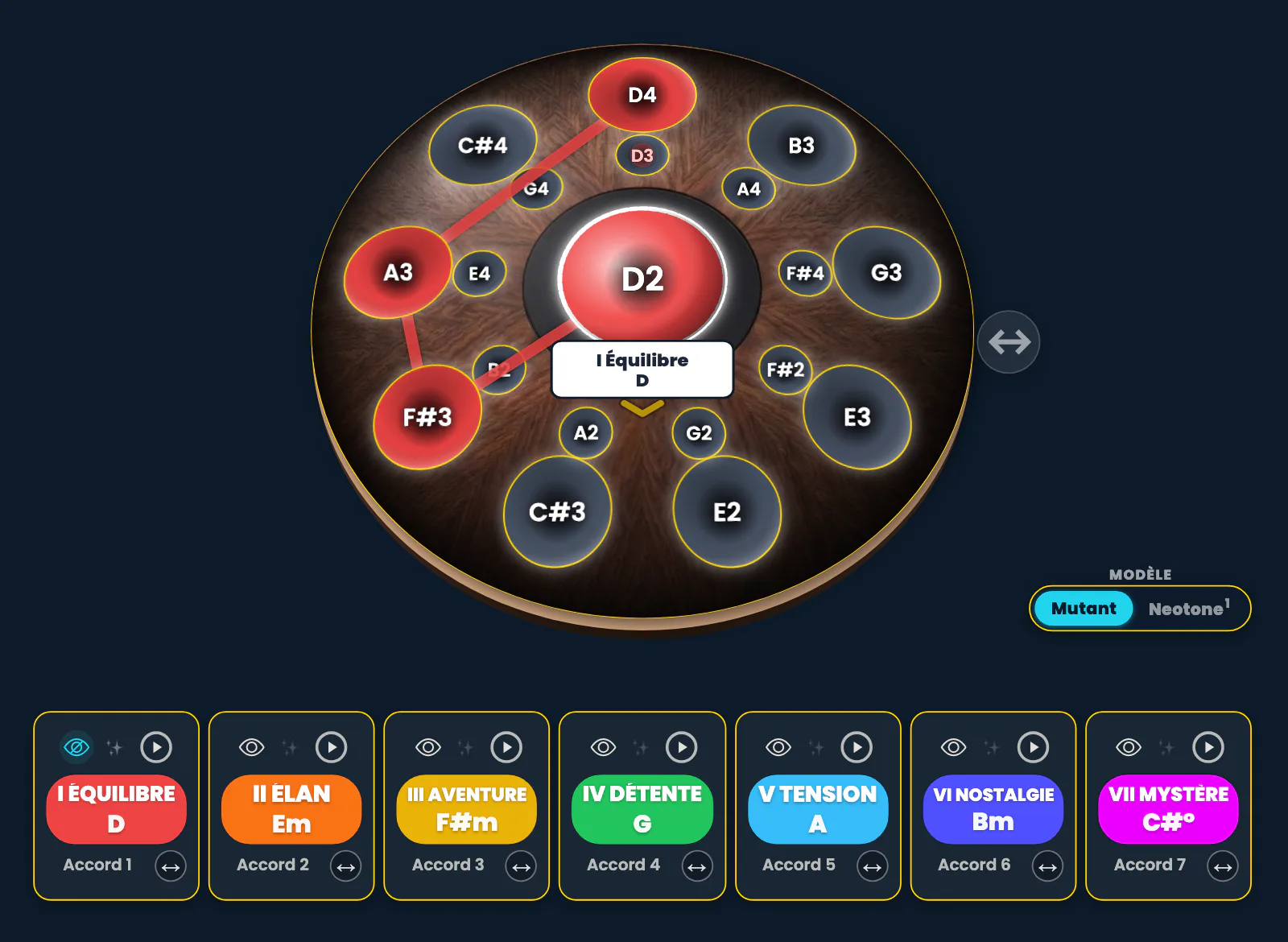
Click the image to open it, then click it again for full size.
And these chords keep the same shape when you change key: that’s the story told in The handpan capo.
You want bass under your voice
Low notes set beneath your singing give a piece its grounding. The vocal layouts show how to use them.
Choose the 10 notes if…
You want to complete your acoustic handpan
You already have an acoustic handpan and you love it. It just lacks bass or a few specific notes for certain pieces. The 10-note Neotone¹ can bring them, set down right beside it.
You keep your acoustic at the centre; the electronic one plays what the other can’t. The article Completing your acoustic handpan with a Neotone details this case.
The Mutant can do the same thing. It becomes interesting if you sing while playing: its extra notes leave you room for the melody, above the chord. The same article compares the two.
You want to discover the handpan
Ten notes make simple ground for your first steps. You hear music that makes sense right away.
You want to improvise or meditate within one scale
A single scale, under your fingers, without searching for anything. This is the most natural use of the handpan.
You want a lighter and more accessible instrument
Fewer notes, no screen: the 10-note model is the simplest and cheapest. Up-to-date prices are in the calculator.
In summary
| Your project | Neotone¹ — 10 notes | Neotone¹ Mutant — 19 notes |
|---|---|---|
| Completing your acoustic handpan | ✓ | ✓ |
| Discovering, improvising, meditating | ✓ | ✓ |
| Making it your main instrument | ✓ | |
| Accompanying your voice on well-known songs | ✓ | |
| The 7 degrees in major and minor | ✓ | |
| A screen built into the instrument | ✓ |
To understand why an electronic handpan in general might interest you: Why choose an electronic handpan.
And if you’re hesitating
The simplest thing is to play both. Come and try them at the showroom in Paris: your hands will quickly tell you which one speaks to you. And to compare prices for your country, the calculator will do the math for you.
Ready to make your colours sing?
Try the app for free, or discover the electronic Neotone handpan.